
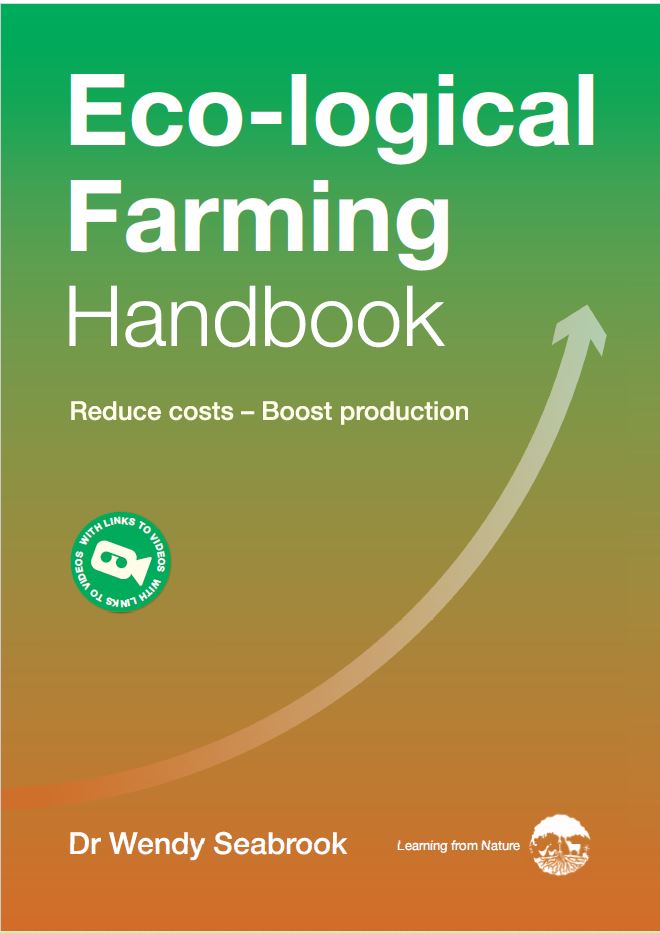
Ecological Farming Handbook
Get Support with Growing Food
Most modern farming relies on external inputs to replace functions that a healthy ecosystem can perform for free. When we dismantle these natural partnerships, our costs go up and the resilience of our production systems goes down. This Ecological Farming Handbook shows you how to repair these broken systems so you can learn how to:
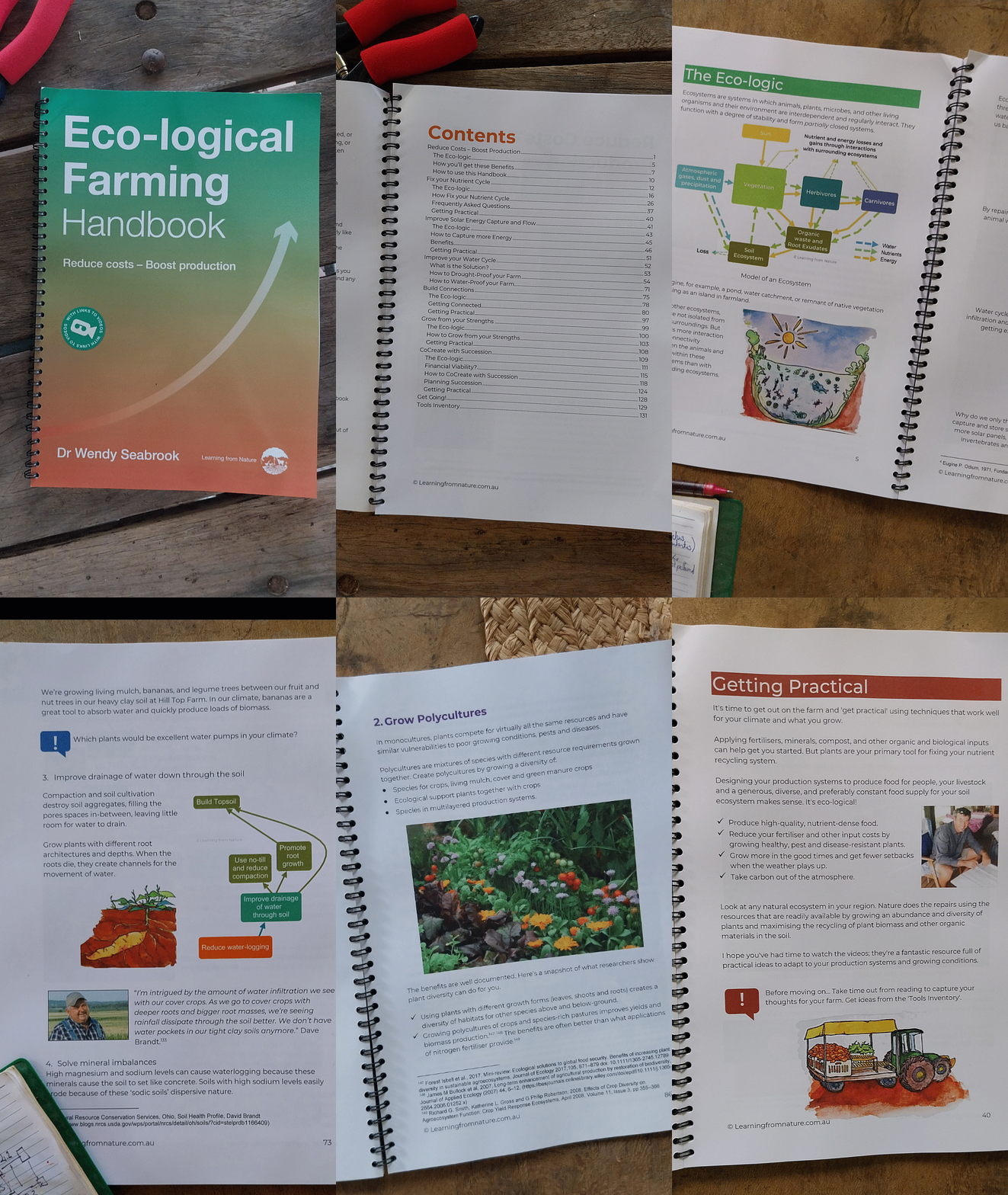
The Ecological Farming Handbook, by Dr. Wendy Seabrook, is over 100 pages packed full of clear diagrams, success stories, and links to hands-on videos showing how farmers apply the principles.

Need more information about the Ecological Farming Handbook? Then read on…
Superb Value
With the Ecological Farming Handbook, you get much more than a ‘how-to’ of regenerative practices like cover, multi-species, and alley cropping, applying compost and using no-till. You get professional advice from over 20 years of research and practical experience with using this eco-logical approach to regenerative agriculture.
With the eco-logic explained, instructions supported by clear diagrams, a comprehensive toolkit of regenerative practices, and links to videos showing how other farmers use this approach, you'll gain the know-how to fix the growing issues holding you back - above and below ground!
This practical and science-based Handbook is organized into six sections:
The Author
Dr Wendy Seabrook, is one of the world's leading experts on eco-logical approaches to farming. She demonstrates that while ecosystems are complex, repairing them isn’t complicated when we support Nature's experts, the life in our soil and biodiversity above ground.
Whether growing in a smallholding in India, a commercial orchard in Brazil, or running cattle in outback Australia, Wendy demonstrates that while ecosystems are complex, repairing them isn’t complicated. Applying the well-designed and thought-through principles in the Handbook, you can concentrate on what's essential and develop effective solutions for your climate and other growing conditions.
Solidly grounded with the latest research, Wendy translates the science into an easily digestible format and reveals how farmers around the world benefit from growing food eco-logically.
What people say about the Ecological Farming Handbook
"This beautifully illustrated handbook presents practical, hands-on guidance for farmers wishing to improve both the productivity and sustainability of their land.
Dr Seabrook draws on the experiences of farmers worldwide alongside her own work at Hill Top Farm in tropical Australia. She emphasizes the need for growers to define their goals and apply ecological principles to achieve them.
The handbook demonstrates how working with nature improves soil fertility, minimizes pests and diseases, and reduces the impacts of drought to maximize production, all without reliance on expensive agrichemicals. This farmer-friendly, wildlife-friendly, and climate-friendly approach applies globally, from resource-poor smallholders to large-scale agricultural enterprises."
Prof Roger Leakey, former Professor of Agroecology and Sustainable Development (James Cook University), and former Director of Research at The World Agroforestry Centre (ICRAF)
"Wendy Seabrook is on the money when it comes to regenerative agriculture. Her teachings and advice are being shown to markedly improve lands used for farming and cropping. I especially enjoyed reading her 'Eco-logical Farming Handbook' where every page is full of information that creates more 'wow moments' than I thought possible! A great read."
Charles Alder, CVO / CEO EcoForce Australia, Co Founder of Rural Aid
"The great thing about the Eco-logical Farming Handbook - we are on a journey and understand where we want to go."
Martin Lines, UK Chair, Nature Friendly Farming Network
"Extraordinary!"
Jessica Peace, Organic vegetable producer, UK
"Thank you so much for writing your book. It is a most concise, yet comprehensive guide to regenerative food production systems I have come across. I have had contact with several of the people referred to in your book, but it is difficult to bring all of the different ideas and practices together. The Handbook does that brilliantly."
Peter Stray, President of the Geelong Landcare Network, Victoria, Australia
Frequently Asked Questions
Does the size of my property matter?
Size doesn't matter. Smallholders, market and community gardeners, large-scale crop and grazing operations improve their soils and reduce crop losses by repairing the ecological systems in their production systems.
Will the 'eco-logic' work with what I grow?
Yes, the fundamental principles are applicable whatever your climate and production system. There are orchardists, dairy farmers, market gardeners, grain producers, grazers, and even hydroponic growers benefiting from using this eco-logical approach to regenerative agriculture.
Will this Approach Work in my Climate?
Farmers from the cold north of Scotland to Africa's hot, sultry tropics and arid landscapes use this ecological approach. The ecological principles are the same. Tools, techniques and species differ as growers adapt these practices to their climate.
Will I harvest less food?
Farmers often experience higher and more reliable yields, less damage from pests, diseases and extreme weather. They also create opportunities to increase their income streams by stacking new enterprises within their production systems.
Reduce fertiliser costs
Reduce pests problems
Drought and water-proof your farm
Recover quicker extreme weather

© Copyright Learning from Nature.
All Rights Reserved