
How much are you spending on mulch every year for your vegetable beds? Because what if I told you that every bag you spread is actually keeping your soil on life support — and there’s a permanent living system that does the job better, for free, without you buying or spreading a single bag.
We’ve been trialling a living mulch system in our market garden at Hill Top Farm — and what we discovered changes the way you think about mulching your vegetable beds entirely. Today I’m going to show you what living mulch is, the science that makes it outperform conventional mulch, and how we’re setting it up around our pumpkins right now.
Most of us were taught to mulch bare soil between crops. And mulch is good — I’m not saying it isn’t. It protects your soil surface and adds some organic matter. But here’s what the research is now showing us: surface mulch feeds your soil biology almost nothing compared to what living plants deliver from beneath the ground.
Because what the gardening industry doesn’t tell you is this: plants push roughly 25 to 30% of every sugar they produce through photosynthesis — out through their roots. When scientists first discovered plants doing this, they were so confused they actually called it the ‘leaky root syndrome.’ They thought something was wrong with the plants.
We now know that wasn’t a flaw. That was the design. Plants are actively supporting the biological workforce in the soil by providing them with a constant food source so that they supply them with nutrients, improve the soil structure for their roots, improve water availability. Surface mulch sits on top of the soil and gets eaten quickly, and those organisms breathe out the carbon as CO₂, just like we do. But living roots? They’re feeding the system from beneath — continuously, 24 hours a day, all season long.
So if mulch alone isn’t the answer — what is? A permanent living ground cover. Right underneath your crops. And here’s where it gets interesting…
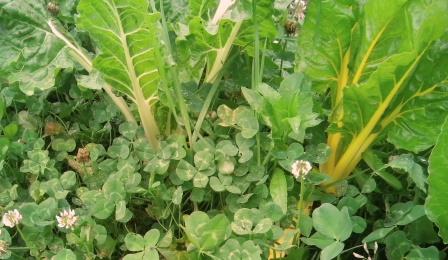
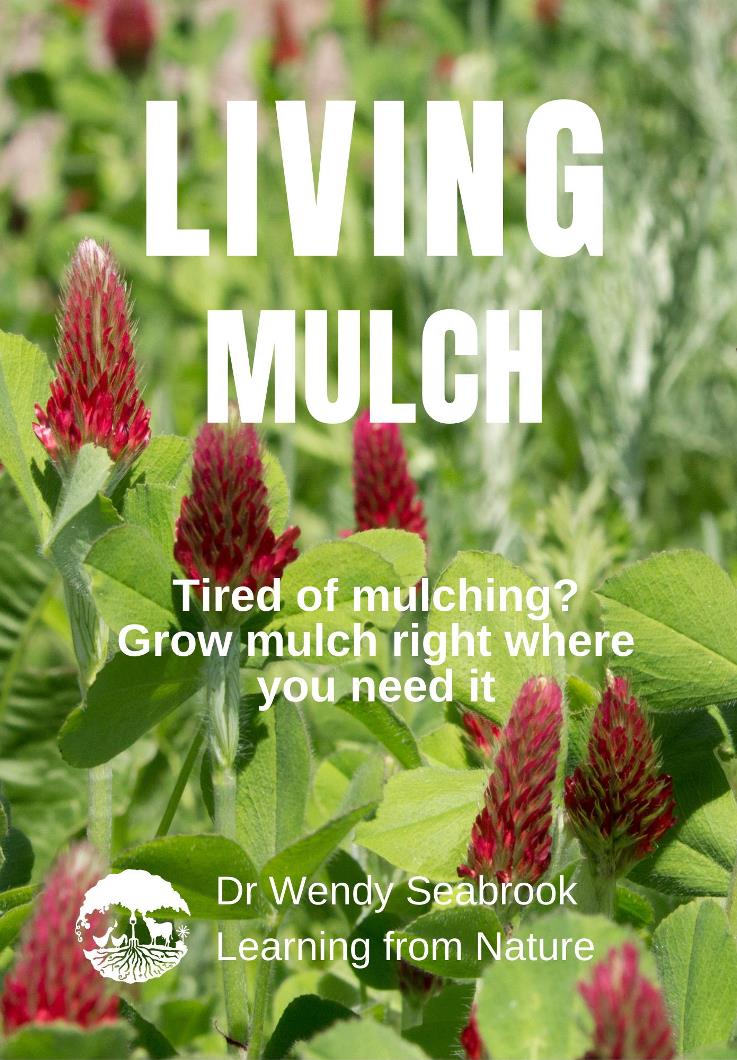
Living mulch is a mixture of low-growing perennial and self-seeding ground cover plants grown as a permanent cover. Not a cover crop that you get rid of before planting your main crop. Living mulch is a permanent system that stays in the ground and keeps feeding your biological workforce year-round. No break in the system. No bare soil. No gap in the root exudate supply.
We started our trial at Hill Top Farm using cow peas. Is that the ideal species? Not entirely — ideally you’d want a more diverse mix of species, and we’re working on that. But cow peas are a legume, which means they’re pulling nitrogen directly from the air and building it into your soil. And they self-seed easily — so you’re not constantly buying or re-sowing seed. They just keep going.
he other thing that makes them ideal to start with is how manageable they are. They’re producing a dense, continuous living cover. Leaves are dropping constantly onto the soil. Root exudates are flowing. The microbes underneath are thriving.
Here’s how we set it up practically: we simply make a hole in the cow pea cover and plant our vegetable seedlings through it. Well-advanced seedlings — so they’ve got a strong head start. Then we let the cow peas keep growing underneath while the vegetables establish above.
As you watch this video, look at how they’re producing a dense, continuous living cover. Leaves are dropping constantly onto the soil. Root exudates are flowing. The soil life underneath are thriving.
Now — why doesn’t every gardener do this? Because it is genuinely tricky. Managing the balance between your vegetables and your ground cover plants takes observation. Most commercial producers still use cover crops that get incorporated before planting — and that works. But it’s a break in the system. The moment you slash and dig that cover in, you lose the living root network. You lose the continuous root exudate stream. And your soil biology has to start rebuilding again.
Getting permanent living mulch right takes more management upfront. But once it’s established, the maintenance drops dramatically — and your soil biology never stops working.
The result is a genuine win-win. Less money spent on mulch. Less backbreaking work spreading it. And a permanent living system growing underneath your vegetables that’s improving your soil biology every single day — in a way that bags of mulch simply cannot replicate. Your crops get better self-service catering from the whole ecosystem.
Contrary to what the conventional approach would have you believe, the solution here isn’t more inputs. It’s more life in the ground. And Living Mulch is one of the best tools we have to achieve this
>>>Everything you need to know – Living Mulch Handbook<<<